The AI energy manager for commercial buyers.
Big industrials have energy consultants and managers. Medium-sized companies get brokers who disappear after they've signed a supply contract. Small businesses are left to their own devices. Kyber analyzes your energy spend and consumption patterns, finds ways to reduce your costs, replaces your broker to get the best possible contract, and keeps you informed year round.
SMEs don't get the help they deserve to understand, manage, and reduce energy costs.
Small accounts are ignored by brokers because they generate too little commission, and the mid-size businesses that do use them are poorly served. Brokers lock in a supply rate, bake their commission into the price without telling their customers, and disappear once the contract is signed. Demand charges, often the single biggest component of a commercial energy bill, go unmanaged. And clients get no help understanding where their energy costs come from.
The status quo
Brokers give you a rate for the supply part of your bill, tell you nothing about delivery costs, and then are heard from no more.
Kyber
Continuous analysis of your energy consumption and costs, the best supply rate when it's time to sign, and energy costs kept crystal clear year round. No hidden markups: we earn one flat, disclosed commission, identical across every supplier, so our advice never steers you.
From bills to savings in three steps.
Upload or connect
Upload PDFs or your utility's interval data export. Our AI parses every line of your bills and analyzes your consumption patterns to build a complete picture of your costs, demand, and rates.
Every lever in dollars
We break it down into supply costs, delivery costs, and demand rates, flag billing errors and rate category mismatches, and quantify every saving you could make.
Findings become savings
We run competitive supplier bids, enroll you in utility incentive programs, and show you how to lower delivery costs by adapting your consumption patterns.
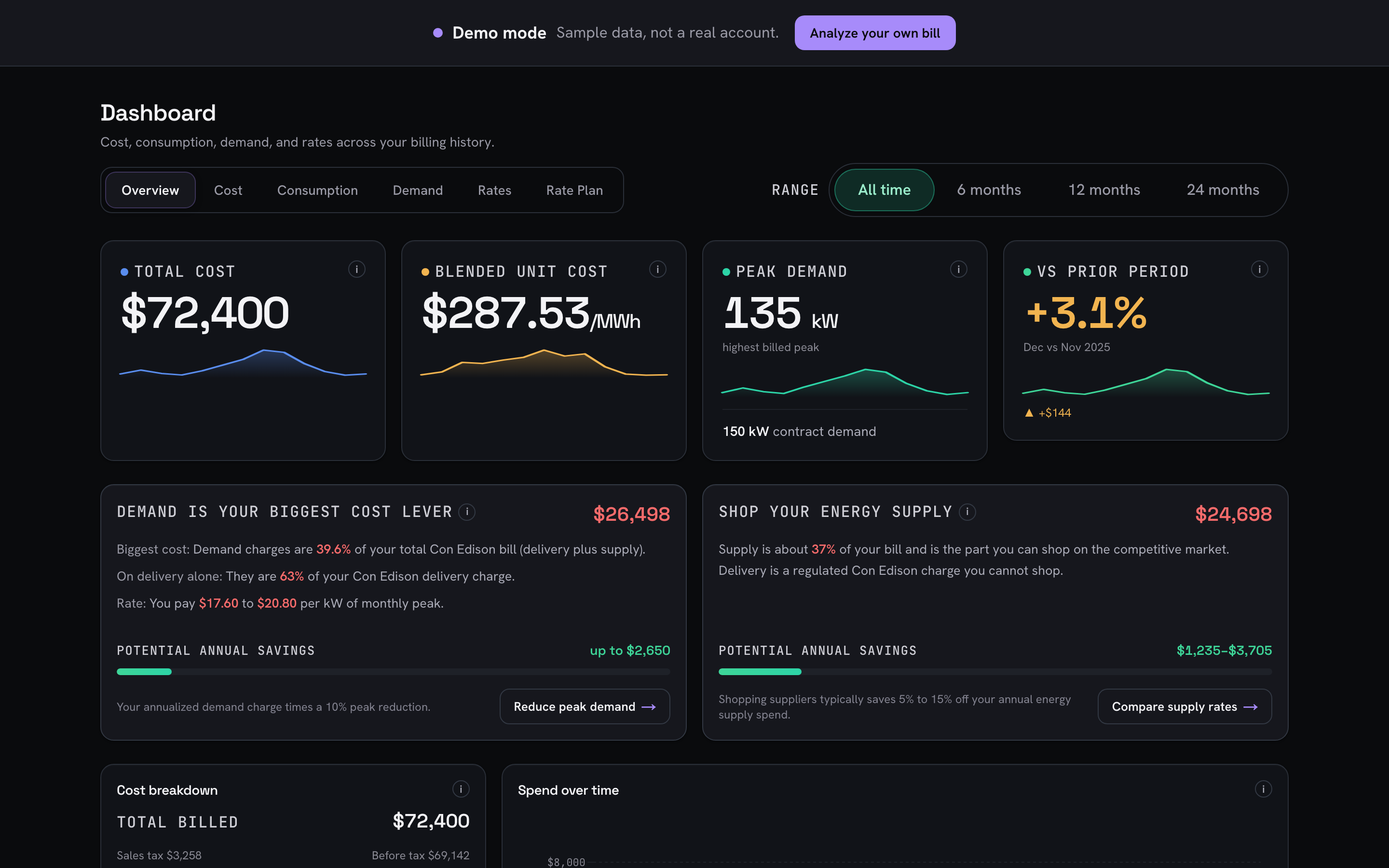
One place to see your whole energy spend.
Kyber turns your utility bills into a live dashboard: what you pay, why, and what to do about it. No spreadsheets required.
See everything the platform does →
Wherever you can choose your supplier.
Kyber is active in deregulated energy markets across the United States, where a business can choose its electricity or natural gas supplier instead of defaulting to the utility. If you have locations in Texas, New York, Illinois, Ohio, Pennsylvania, Michigan, Virginia, New Hampshire, Massachusetts, Rhode Island, Connecticut, Maryland, New Jersey, Washington D.C., Maine, or Delaware, Kyber can help you save on your energy contracts.
Electricity
Bill analysis, demand charge management, and competitive supply procurement. Fixed, index, and blended structures.
Natural gas
Supply procurement for commercial and industrial accounts in deregulated markets.
For one New York City food catering company, a single fifteen-minute spike in usage each year set 50% of their electricity costs. Seeing it, and knowing how to fix it, took a five-minute analysis with Kyber.
Run the analysis for free on your own bills.
Upload a recent utility bill and see what Kyber finds: cost breakdown, demand analysis, and where the savings are. Or explore the demo on sample data first.